Boating Safety Consultations
Working towards a healthy and safe river, shared and enjoyed by all.
Did you know?
- This project is a result of concerned community elders who approached the Friends of the Gatineau River (FOG) about safety and environmental problems about the river.
- Use of heavy and mixed recreational, width of the river and boating speeds poses threats to public and environment safety of the Gatineau River between Wakefield and the Chelsea Dam.
- In May 2021, a survey was conducted of 700 users of the river. Here are some highlights.
-
-
- 87% rate the river as dangerous and the majority fear that someone will eventually be seriously injured or killed,
- 94% recognize the negative impacts of boat wakes on other users and the environment,
- 81% support reductions from the current 55 km/h speed limit, and
- Hundreds of concerned citizens felt compelled to submit written accounts about near-collisions, safety for their children and loss of enjoyment .
-
-
Issues Related to Boating Safety
Environmental: Environment safety concerns come from heavy recreation use, excessive-high speed by motorboats, etc.
Safety: We care about the safety of the residents. A risk that someone will get injured due to the current conditions of the River. Public and Children safety who can’t access a safe and enjoyable environment due to risk of near-collisions, etc.
For more background information, please refer to this presentation.
Interactive Map
Explore the map to learn about river dimensions, recreational hotspots, access points, and more.
What We’re Doing
Below is a summary of activities and research conducted by our volunteers in 2021.
Gatineau River Users Survey
A survey in May 2021 reuniting 679 of Gatineau River users.The objective of these surveys consists of gathering the public opinion on the safety and environmental concerns regarding the Gatineau River. Here are some highlights.
- 90-91% engage in swimming and paddling; 34-44% enjoy power boating for fishing and cruising; (13%) water skiing, wakeboarding (8%) and personal watercraft (5%) activities,
- 87% perceive the river as dangerous and can cause injuries or death; 94% acknowledge the impact of boat wakes.
- 81% support reductions in the current 55 km/h speed limit,
- 85% support transition to zero-emissions recreational activity on the river by 2030
- Hundreds citizens submitted concerns about near-collisions and safety.
For the full report and presentation of the survey results click here.
Preliminary assessment
A Preliminary Assessment form was submitted to Transport Canada by the MRC des Collines with the support of FOG to identify some of the issues related to boating safety.
-
-
- Resolutions were passed by the MRC des Collines as well as the municipalities of Chelsea and La Peche to support the launching of the initiative
- Transport Canada approved the initiation of this project, recognizing the need to address the issues.
-
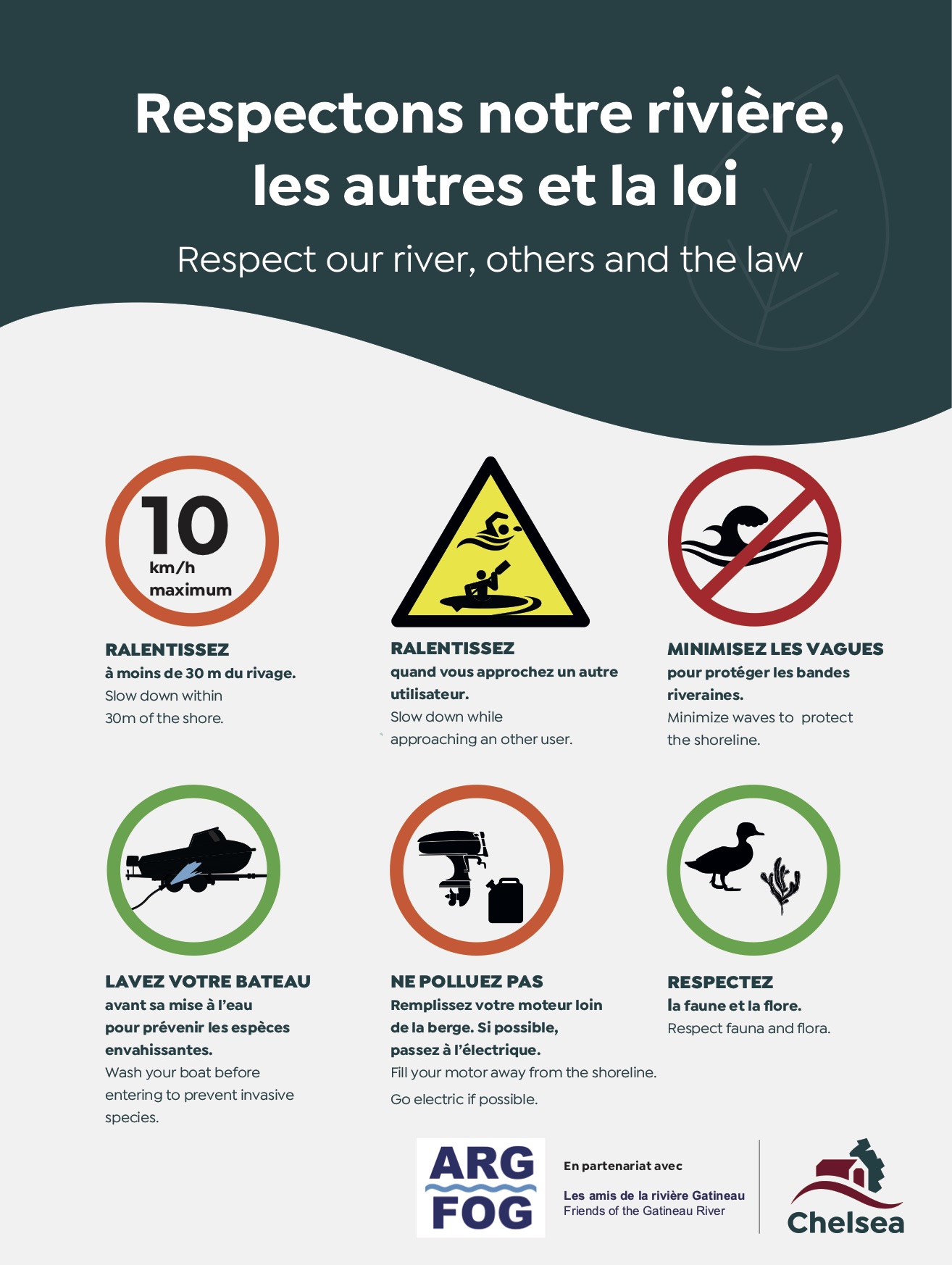
River etiquette sign
FOG designed the River Etiquette sign on the right, in collaboration with the Municipality of Chelsea. It was installed at the Farm Point boat launch in Farm Point.
River Usage Monitoring
Here are some highlights of data collected about river usage.
- Paddling and boating groups: 40,000+annual paddling and sailing trips by:
- Expeditions Wakefield: 9,000 paddlesport rentals
- Club Cascades: 15,900 canoe and kayak excursions
- Gatineau River Yacht Club: 3,300 sailing trips
On Water Census
Many swims and paddlesport outings by residents and visitors occur along the river via private docks and access points.
An on-water census was conducted. In 2021 we found 597 private docks and 209 residents powerboats.
-
- La Peche: 103 docks with 32 boats (31%)
- Chelsea: 333 docks with 100 boats (30%).
- Cantley: 161 docks with 77 boats (48%)
- Boat types: Personal Watercraft (PWC/jetski): 2% or just 5 PWCs; pontoon: 33%; outboard: 18%; cruiser: 41%; sailboat with outboard: 5%
Monitoring program
A boating monitoring program was conducted in 2021, observing nautical traffic at 10 locations including the Farm Point boat launch. This was a result of 109 sessions totalling 297 hours of volunteer time.
Here are some highlights:
Farm Point Boat Launch
- This sustainable boating brochure was distributed to boater at the boat launch while discussing the new River Etiquette sign.
- Average of 16 paddlesports and 10 powerboats launched daily
- The breakdown of boat types were as follows: 27% fishing, 3% pontoon, 54% cruiser, 14% PWC, 2% wake boat
- The detailed report can be found here.
On the river observations
- A total of 1270 passing powerboats were observed during the 109 sessions. The breakdown of boats were as follows :
- PWC: 132 or 10%,
- Pontoons: 334 or 26%,
- Outboards: 277 or 22%,
- Cruisers: 479 or 38%,
- Towing: 48 or 4%
Boating speeds
- Traffic levels vary considerably by days of the week and time of day
- Powered traffic at peak times was 10-20 vessels per hour (a vessel passing every 3-6 minutes) at most locations
- Humain-powered traffic was consistently higher, with peaks reaching 45 per hour in Wakefield and 78 per hour at GRYC
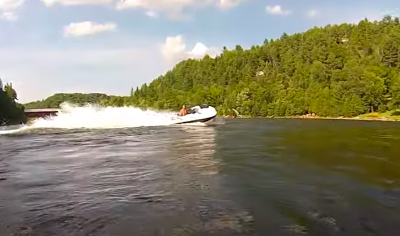
- 127 (10%) travelled at excessive speed, over 55 km/h.
- 446 boats (35%) travelled at a very slow speed (under 10km/h).
- 651 boats (51%) travelled at high speed but within 55 km/h.
- Percentages of powered vessels that were observed to be travelling at excessive speed: jetski 23%, pontoons 4%, outboards 7%, cruisers 13%
- Percentages of powered vessels travelling at slow speed, generating no significant wake: jetski 3%, pontoons 59%, outboards 45%, cruisers 25%
- The detailed observations can be found here.
Public Consultation
- In June 2021, a public consultation was held to hear about the public’s concerns about boating safety and environmental impacts.
- It was attended by 86 people: representing major stakeholders groups.
-
- 18 provided written submissions prior to the session.
- 5 panellists made formal presentations
- 14 attendees made live verbal presentations
- 33 people submitted 98 questions or comments during the meeting
-
To view the recording, click here.
Boating research of water ways
- A 10 km/h speed limit within 150-300 m of shore is recommended for safe and sustainable boating by multiple studies.
- According to a research, above 10 km/h, most boats generate damaging wakes :
- “Displacement mode” (<10 km/h): Boats create non-damaging wakes
- “Transition mode” (starting at 15 km/h): Largest, most damaging wakes
- “Planning mode” (higher speeds): Less damaging than transition mode, but still more damaging than displacement mode.
- Damaging wakes can travel:
- 150 m from small boats according to wake decay research
- 300 m from wake boats according to a Quebec study
- Various waterways across Canada have adopted similar speed limits to address safety and environmental concerns
- Specific limits would include 5 km/h for narrow rivers and 10 km/h for dense recreational shorelines
- Ideal towing speeds range from 21-55 km/h for activities like water skiing, tubing, trick skiing, kneeboarding,etc. But 35 km/h is enabled as the ideal speed for a variety of activities.
Next steps
- Another consultation is required to decide what to include in the submission of Transport Canada.
- A request is to be submitted to Transport Canada for specific changes to speed limits and/or other boating restrictions.
References
Transport Canada Vessel Operation Restriction Regulation (VORR) Guide
The VORR laws and vessel restrictions currently in force across Canada
Transport Canada Safe Boating Guide
Ideal speeds for towing activities
Quebec research on the distance required for the waves from wake boats to dissipate
What you can do
Write to your councillors, mayors and MRC prefect requesting changes
Collective advocacy can contribute to positive changes in the rules governing boating activities of the Gatineau River.
Practice Responsible Boatings
Adhering to existing rules and regulations while staying informed on ongoing campaigns.
Participate in upcoming public consultations
To be informed about environmental impacts and safety risks associated with high speed boating by attending workshops and future regulatories
Frequently Asked Questions
What are the current speed restrictions on the Gatineau River?
History: high speed motor boats have been recognized as a problem on the narrow river since shortly after the logs stopped running. Friends of the Gatineau was founded in 1991 and immediately started a many-year effort advocating for speed limits. Finally, in 2000, Chelsea and Cantley jointly petitioned the Québec government, leading to the current speed limits being established for the 2002 season. Friends of the Gatineau River pressed for a much lower speed limit but was unsuccessful in the face of opposition from local boaters.
What other laws and regulations apply to motor boating on the Gatineau River?
- It is a criminal offence (Section 249 1b) to operate any type of pleasure craft in a fashion that is dangerous to the public. Thus, it is illegal if an operator operates dangerously close to other vessels, or operates at dangerously high speeds, or disturbs swimmers with the vessel’s wake, or fails to slow the vessel when visibility is reduced.
- It is a criminal offence to consume drugs or alcohol while operating any type of vessel (Section 253 a), or to operate a vessel while in any way impaired by drugs or alcohol (Section 253 b).
Other regulations require pleasure craft operators to:
- Stay well clear of swimmers, paddle craft, wildlife, and waterfront properties
- Adjust speed to reduce noise whenever possible so as not to be an irritant to other users or to waterfront residents.
- Adjust speed so that your wash and wake will not disturb others, erode shorelines, disturb wildlife, or damage property.
- Follow the Collision Regulations requirements regarding maintaining a safe speed depending on visibility and water conditions.
- Know and comply with all boating restrictions (engine power limits, speed limits, etc.) in effect where you are operating.
- Use courtesy and common sense so as not to create a hazard, a threat, a stress, or an irritant to others or to the environment.
Source: Pleasure Craft Operators Card Study Guide
What boating restrictions are possible under Transport Canada’s Vessel Operation Restriction Regulation (VORR)?
- All vessels prohibited
- No power-driven vessels (includes electrical propulsion)
- No power driven vessels (electrical propulsion allowed)
- Engine power limit
- Speed restriction
- No power driven vessels towing a person (skis, wakeboard, etc.)
- Permit is required to hold a sporting or recreational event
Additionally, these restrictions can:
- Apply at all times
- Apply to certain times of the day, week, month or year
- Target a particular type of craft
Why is 10 km/h the near-universal speed limit for minimizing wake impact?
Research shows that most boats are in “displacement mode” below 10 km/h, where the boat is level in the water, creating wake waves that are no more damaging than naturally-occurring wind waves. Speeding up, even to just 15 km/h, most boats enter “transition (or plowing) mode,” creating the largest, most damaging wakes. For some boats, a further speed increase allows the hull to enter “planing mode”, where the boat levels, less hull area contacts the water, and the wake produced is less damaging than the transition mode, but still significantly more damaging than displacement mode.
That’s why 10 km/h (or the slightly lower limits of 5 mph or 5 knots in other countries) is the universal standard, except in very narrow channels where 5 km/h is sometimes used. In Quebec alone, over 60 water bodies have a speed limit of 10 km/h extending 100 m or more from shore.
Why do 10 km/h slow-speed zones often extend 100 m or more from shore?
That’s why over 60 water bodies in Quebec have 10 km/h speed limits extending from 100 m or more from shore.
Which other water bodies in Quebec have VORR speed restrictions?
59 small Quebec lakes have limits of 10 km/h that extend 100 m or greater from shore. In most cases, the limits were sought because of dense recreational usage. Some limits extend up to 200 m from shore. The breakdown:
- 16 lakes have a 10 km/h limit for the entire lake
- 37 lakes have a 10 km/h limit within 100 m of shore
- 6 lakes have a 10 km/h limit extending greater than 100 m from shore, including: Lac Maskinongé at 150 m, Bassin de Chambly at 125 m, Lac Aylmer at 200 m, Lac Nairne at 200 m, Lac Brome at 150 m
13 narrow rivers (typically 25-60 m wide) have 5 km/h speed limits.
Dense recreational shorelines on some large rivers have 10 km/h limits extending 300-600 m from shore, including: Des Deux Montagnes, 10 km/h within 600 m of the shore of the waterfront village of Saint-Placide; St. Lawrence River near the entrance to the Lachine canal: 10 km/h within 300 m of shore.
No other river in Quebec has the Gatineau’s combination of: narrow width, calm waters, extent of waterfront residential development, and intensive use for swimming, paddling, floating, and dinghy sailing. The physical and usage characteristics of the Gatineau are closer to those found on the many small lakes listed above.
Who can enforce VORR restrictions?
- The local police force (MRC Police or Sûreté du Québec)
- Specially-designated parties, as has been implemented in 24 places in Quebec, mostly in the Eastern Townships. The MRC must apply to Transport Canada for this designation.
What is the minimum speed required to support towing activity?
- Children water skiing: 21-26 km/h
- Tubing 13-40 km/h
- Adult Trick Skiing 18-34 km/h
- Adult Slalom Skiing 30-55 km/h
- Adult Kneeboarding 26-31 km/h
- Wakeboarding 26-30 km/h